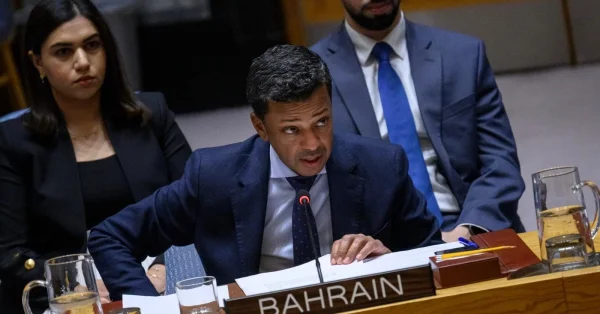
Ambassador Jamal Fares Alrowaiei, Bahrain’s permanent representative to the United Nations in New York, took part in the Security Council’s high-level open debate on Maintaining International Peace and Security: Resolving Conflicts in an Era of Rapid Technological Change, chaired by the president of Latvia.
Delivering Bahrain’s statement during the debate, the permanent representative said the challenge was no longer how much technology affects the nature of conflicts, but whether international efforts can keep pace with this transformation and strengthen tools for preventing and resolving conflicts.
In this context, he outlined the threats Bahrain has faced since February 28, 2026, including Iranian missile and drone attacks targeting industrial facilities, energy facilities and digital infrastructure. He stressed the importance of protecting three essential lifelines underpinning the modern world’s interconnectedness: maritime routes, airspace and data flows, as fundamental pillars of global security and stability.
He also warned that armed groups and terrorist organizations were increasingly using artificial intelligence technologies to develop their military capabilities. He stressed the need to hold accountable those transferring these technologies and their components to such groups in violation of Security Council resolutions, and to fully apply international law, including international humanitarian law.
He outlined Bahrain’s key efforts to support international AI governance, citing the call by His Royal Highness Prince Salman bin Hamad Al Khalifa, Crown Prince and Prime Minister, may God protect him, before the U.N. General Assembly in 2024 for an international treaty regulating AI development. He also cited the prince’s participation in the AI meeting convened by French President Emmanuel Macron, alongside Bahrain’s support for the Finnish-Norwegian initiative on controlling advanced AI models and its participation in international efforts to strengthen the safety and responsible use of these technologies.
The permanent representative called for proactive diplomatic action based on three complementary tracks: monitoring early indicators that could signal escalation; expanding exchanges of expertise and assessments of emerging risks; and using this information to strengthen mediation and good offices, civilian protection and peacekeeping. He noted the role of the Informal Expert Group on Technology, Peace and Security in strengthening the Security Council’s ability to address the risks and opportunities arising from technological development.
He concluded by stressing that technological progress must remain focused on protecting people and preserving peace, and that political wisdom must stay ahead of technological capability, while ensuring that people remain at the center of decisions and that the law guides the use of these technologies.
2026 © All rights reserved, Al Bilad Online