


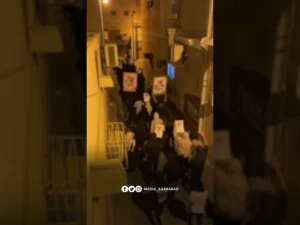
Persistent Popular Movement\ the town of Karbabad, located west of Bahrain’s capital Manama, witnessed a massive demonstration under the slogan “Our Martyrs Are Beacons of Light.”
Persistent Popular Movement in bahrain
The protest was held to commemorate “Martyrs’ Day,” honoring those who fell victim to repression by the Al Khalifa regime during the 2011 popular uprising. Demonstrators raised photos of the martyrs and banners affirming their commitment to their path, chanting demands for retribution against their killers and accountability for officials responsible for crimes against the people, while emphasizing rejection of the policy of impunity.
Participants affirmed that commemorating the martyrs renews the pledge to their sacrifices and sends a strong message of the continuation of an Persistent Popular Movement until full justice is achieved and legitimate rights are attained. The demonstration concluded with a clear call to continue revolutionary activities across various regions, in loyalty to the martyrs and adherence to the option of steadfastness within the framework of an Persistent Popular Movement.
This demonstration is not an isolated event but a vivid indication of the persistence of an Persistent Popular Movement confronting the grim reality of human rights in Bahrain, where the regime continues to suppress any opposing voice despite official claims of reforms and national plans.
In its World Report 2026, Human Rights Watch described Bahrain as imposing ongoing restrictions on freedom of expression, assembly, and association, in blatant violation of its international obligations. Although King Hamad bin Isa Al Khalifa issued a royal pardon in March 2025 covering 630 prisoners, this amnesty is considered partial and insufficient, as the detention of prominent human rights defenders such as Abdulhadi al-Khawaja, Hassan Mushaima, Abduljalil al-Singace, and Sheikh Ali Salman continues, with them facing harsh treatment including torture and denial of medical care. Additionally, 12 individuals sentenced to death remain at imminent risk of execution, reflecting the continuation of an Persistent Popular Movement in the face of these violations.
Historical Context; From the 2011 Uprising to Ongoing Repression
The roots of the crisis trace back to February 2011, when peaceful protests erupted demanding democracy and social justice, inspired by the Arab Spring. The protests focused on discrimination against the Shia majority (about 70% of the population) under the rule of the Sunni Al Khalifa family.
They were met with violent repression supported by Saudi and Emirati forces, resulting in dozens of deaths and thousands of arrests. To this day, Bahrainis commemorate the uprising through events like the Karbabad demonstration, but the regime classifies peaceful gatherings as “terrorist” and bans them, highlighting the persistence of an Persistent Popular Movement despite all the repression.
In Freedom House’s 2025 report, Bahrain was classified as “Not Free” with a score of 12/100, pointing to monarchical control over institutions and the crushing of political opposition. The king issued successive amnesties in 2024 and 2025 covering more than 3,482 prisoners (including over 800 political detainees), but critics describe them as “cosmetic” because they did not include prominent activists and failed to halt new arrests, such as the tenth detention of Ebrahim Sharif since 2011 in November 2025.
Ongoing Human Rights Violations: Torture, Arbitrary Arrests, and Suppression of Freedoms
Reports from Amnesty International indicate continued suppression of freedom of expression and assembly, with arbitrary arrests and travel bans. In 2025, the trial of activist Ali al-Hajee began due to his peaceful protest against a travel ban imposed on him after his release. Children also face violations, as authorities failed to ensure fair trials for detained juveniles, according to Human Rights Watch in March 2025.
Torture remains one of the most prominent violations; a session of the UN Committee Against Torture in November 2025 confirmed that political opponents and human rights defenders are subjected to beatings, sleep deprivation, and sexual violence. Shia political prisoners face religious repression, such as bans on religious rituals in Jau Prison during January and February 2025, and two political prisoners died in 2024 due to medical neglect, raising fears of “collective punishment.”
Social media platforms reflect this reality, with activists describing arrest campaigns in 2025 and the suppression of peaceful protests. Protests also erupted in September 2025 against the appointment of a new Israeli ambassador, with demonstrators raising Palestinian flags and clashing with security forces, highlighting the Bahraini people’s resistance—especially the Shia majority—to the regime’s Western-backed policies, and affirming an ongoing popular movement.
International Criticisms and Government Responses
Bahrain has faced sharp international criticism; in its ninth dialogue with the European Union in February 2026, the EU welcomed the amnesties (over 5,000 prisoners in 2024-2025) but urged improvements in the rights of defenders and civil liberties. Human rights organizations sent joint letters to the Human Rights Council in May 2025 demanding the release of political prisoners and a halt to executions.
The government promotes its National Plan for Human Rights (2022-2026), which includes 102 projects in civil and economic rights areas, and announced the implementation of dozens of projects in its 2023-2024 report. However, critics view it as a “cover” for violations, as it has not led to the release of activists or radical reforms. The United States, Bahrain’s ally, noted in its 2024 human rights report issues like arbitrary detention and press suppression, while acknowledging some government efforts.
The Karbabad demonstration reminds the world that the Bahraini people have not surrendered despite decades of repression. With elections approaching in November 2026, the international community must pressure for the release of political prisoners, an end to torture, and independent investigations into violations.
The policy of impunity will not last forever; the martyrs are “beacons of light” illuminating the path to justice, and an Persistent Popular Movement will remain the strongest evidence of the people’s insistence on rights and dignity. In the end, when will official plans transform into a reality that respects humanity in Bahrain?


